
Hard Water Stains on San Clemente Windows: Your Stage Guide
Published August 2026 · 7 min read
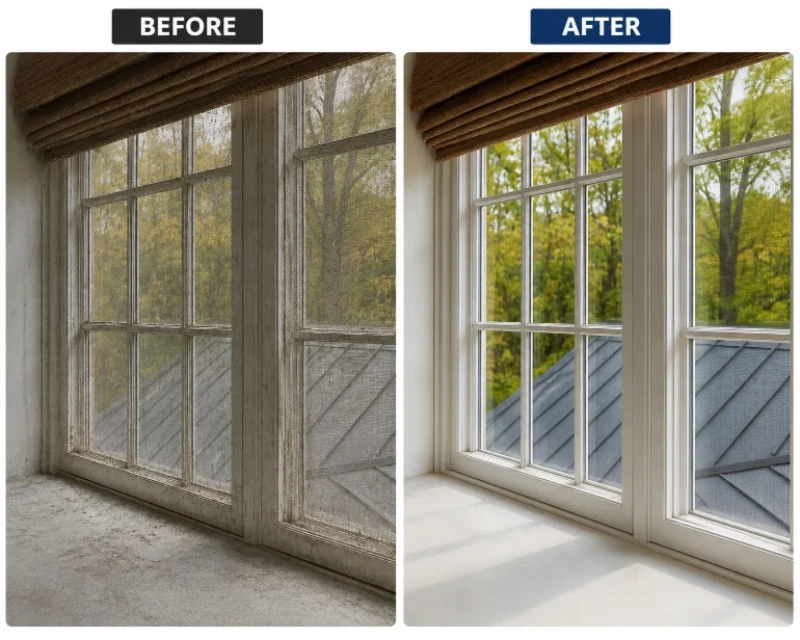
The white haze on your San Clemente windows isn’t dirt. It won’t wipe off. And the longer you wait, the harder it becomes to fix — or the closer it gets to impossible to fix at all.
This guide explains exactly what hard water stains are on San Clemente glass, how to assess what stage you’re at, and what your options are. It also tells you something most window cleaning companies won’t: when treatment is no longer possible.
What Are Hard Water Stains, Actually?
Hard water stains are calcium carbonate and magnesium carbonate deposits — the same minerals that build up inside kettles and on showerheads. San Clemente’s municipal water supply runs at 200–350 PPM dissolved calcium and magnesium. When this water hits your glass through sprinkler overspray and dries in San Clemente’s intense sun, the water evaporates but the minerals stay behind.
Initially this is a surface deposit. But over time, through repeated wet-dry cycles in SC’s 281 annual sunny days, those minerals undergo a chemical bonding process that attaches them to the silica structure of the glass itself. Standard cleaning products — and even professional window cleaning without specific mineral treatment — cannot dissolve these chemical bonds.
The Three-Stage Diagnostic
Run a dry finger firmly across the hazy area. Pay attention to what you feel:
✅ STAGE 1 — Feels: clean, slightly grimy
Surface mineral film or salt residue. Fully removable with standard professional cleaning or even good consumer products. This is the easy stage — don’t let it progress.
⚠️ STAGE 2 — Feels: rough or gritty
Calcium carbonate chemically bonded to glass surface. Standard cleaning won’t remove this — you need low-acid professional mineral treatment that dissolves the calcium carbonate bonds. Treatable. Quote it before starting.
❌ STAGE 3 — Feels: smooth, but still hazy after any cleaning
Mineral compounds have penetrated the glass structure. Permanent. No chemical treatment removes this. The only solution is glass replacement. Any company offering to “treat” Stage 3 is charging you for a service that cannot work.
Why San Clemente Properties Develop Hard Water Stains Faster
Three factors accelerate the progression from Stage 1 to Stage 3 in San Clemente specifically:
High mineral content water. SC’s 200–350 PPM municipal water is at the hard-to-very-hard range. Each sprinkler cycle deposits more calcium than lower-PPM water in other regions would.
Intense UV and heat. SC’s 281 sunny days and direct coastal sun accelerate the evaporation-bonding cycle. What takes 18 months to bond in Seattle bonds in 6–8 months here.
Compounding from other sources. Pacific salt and marine layer calcium add to sprinkler mineral deposits, creating a multi-source contamination layer that progresses to Stage 2 faster than any single source alone would.
What Treatment Actually Involves
Professional hard water mineral treatment uses low-acid solutions — specifically formulated to react with calcium carbonate — to dissolve the chemical bonds holding Stage 2 deposits to the glass. The acid reacts with the calcium carbonate, converts it to a water-soluble form, and it rinses away.
This process requires appropriate safety handling, the right acid concentration for the deposit severity, and thorough rinsing to neutralize residual acidity. It is not something to attempt with consumer vinegar-based products on severe Stage 2 deposits — the chemistry isn’t strong enough, and improper application can cause damage.
A legitimate mineral treatment provider will assess Stage 2 vs. Stage 3 before charging — and will decline to charge for treatment on Stage 3 glass. If a company is willing to “treat” glass and charge for it without diagnosing stage first, that’s a red flag.
Prevention: How to Stop Hard Water Stains from Forming
Fix irrigation misdirection. If sprinkler heads are hitting your windows, redirect them. This is the primary source of hard water staining on SC’s inland properties (Talega, Forster Ranch, Rancho SC).
Use purified water for cleaning. Cleaning with tap water at 200–350 PPM adds mineral deposits on top of existing contamination. Professional cleaning with RO/DI water at 0–5 PPM leaves no mineral residue when it dries.
Clean regularly at the right interval. Stage 1 deposits that are removed before they progress to Stage 2 never need mineral treatment. Oceanfront SC properties cleaned every 4–6 weeks rarely develop serious Stage 2 bonding on the glass itself — only on tracks and frames where deposits accumulate differently.
Not Sure What Stage Your Windows Are At?
Call us — we’ll walk you through the finger test over the phone and tell you what you’re likely dealing with based on your property location and cleaning history. If it’s Stage 2, we’ll quote treatment before starting. If it’s Stage 3, we’ll tell you that too.
☎ Call (949) 883-0250