
San Clemente Window Cleaning: Why Coastal Glass Differs
Published August 2026 · 8 min read
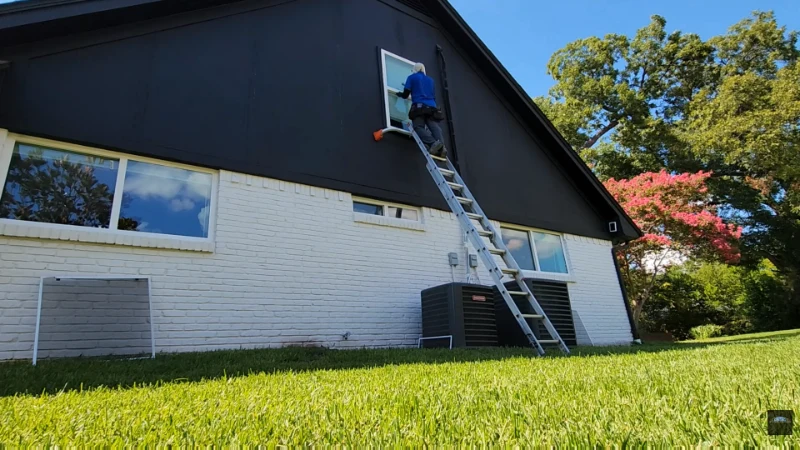
If you moved to San Clemente from inland Southern California, you probably noticed your windows getting dirty faster than they ever did in Riverside or Rancho Cucamonga. You’re not imagining it. San Clemente’s specific geographic position — blufftop coastal, 281 sunny days per year, positioned directly in the path of Pacific onshore airflow — creates glass contamination conditions that simply don’t exist in most of California.
This guide explains why, and what to do about it.
The Four Contamination Sources That Make San Clemente Different
Most cities have one or two glass contamination sources. San Clemente has four operating simultaneously:
1. Pacific Salt Aerosol
Wave action off San Clemente’s coast generates fine salt particles that travel inland on the consistent onshore breeze. These particles land on glass surfaces, attract atmospheric moisture, and form a thin brine layer. As the sun evaporates the moisture — which happens within hours in SC’s dry marine climate — the dissolved minerals are left behind. Each cycle adds another micro-layer. Over weeks, these layers build into a visible white haze.
The rate at which this occurs depends heavily on your property’s position. A home in Pier Bowl with direct westward Pacific exposure accumulates salt deposits visibly within 2–3 weeks during summer. A home in Talega, sheltered by SC’s inland topography, may take 10–12 weeks to show the same level of contamination.
2. June Gloom Marine Layer
From May through August, San Clemente’s coastline is regularly blanketed by marine layer fog overnight and into the morning. This fog contains dissolved calcium and magnesium from the ocean. As it condenses on glass surfaces and then evaporates in the morning sun, it leaves mineral deposits behind — every morning, for four straight months.
Standard window cleaning that removes surface dirt does nothing to address marine layer mineral deposits. These require professional mineral treatment or, at minimum, the purified water system that leaves no additional minerals when it dries.
3. Santa Ana Wind Particulate
Santa Ana wind events send hot, dry desert air from the Ortega Mountain corridor toward the coast. This air carries fine silica particles — desert dust that is significantly more abrasive than typical atmospheric dust. When Santa Ana dust lands on glass and is then wiped without pre-rinsing, it scratches the glass surface.
This is why professional window cleaners in San Clemente always pre-rinse with water before any tool contacts the glass — to remove abrasive particles before any friction is applied. Never wipe Santa Ana-dusted glass dry.
4. Hard Municipal Water at 200–350 PPM
San Clemente’s municipal water supply contains 200–350 PPM dissolved calcium and magnesium — classified as “hard water.” When sprinkler systems spray this water on your glass (through overspray or misdirected heads), and the sun then dries it, those calcium and magnesium compounds bond to the glass surface.
This is particularly impactful for ground-floor windows on properties with irrigation systems. It’s also why professional cleaners use purified RO/DI water at 0–5 PPM — when tap water at 200–350 PPM is used to clean already-contaminated glass, it adds mineral residue on top of the existing contamination.
The Three Stages of Mineral Damage — and Why Stage Matters
Not all mineral-hazy glass is the same. San Clemente window cleaners need to distinguish between three distinct stages:
Stage 1: Salt or mineral film on the glass surface. Fully cleanable with standard professional cleaning.
Stage 2: Calcium carbonate chemically bonded to the glass surface. Not removable with standard cleaning — requires low-acid professional mineral treatment that dissolves the calcium carbonate bonds.
Stage 3: Mineral compounds have penetrated the glass structure itself. Permanent — no treatment restores this. The only solution is glass replacement.
The diagnostic test: run a dry finger across the hazy area. Rough or gritty = Stage 2, treatable. Smooth but still hazy despite cleaning = Stage 3, permanent.
In San Clemente’s oceanfront zones (Pier Bowl, Cyprus Shore, T-Street), the timeline from Stage 1 to Stage 3 can be as short as 6–12 months without professional maintenance. This is why cleaning frequency matters more here than in most California cities.
How Often Should You Clean?
🌊 Oceanfront (Pier Bowl, Cyprus Shore, T-Street): Every 4–6 weeks
🏘️ Blufftop coastal (North Beach, Riviera District): Every 6–8 weeks
🏡 Near-coast & Inland SC: Forster Ranch every 8–10 weeks · Talega & Rancho SC every 10–12 weeks
The late October clean is non-negotiable for all San Clemente zones — it removes summer marine layer accumulation, clears tracks before the first winter rain seals compacted Santa Ana dust permanently, and prepares glass for the upcoming Santa Ana season.
Ready to Schedule Window Cleaning in San Clemente?
Tell us your neighborhood — we know every street’s specific exposure profile and can give you an accurate quote on the spot.
☎ Call (949) 883-0250